
Fractions Explained: Half-Inch and Three-Quarter Birch Sheets
Half an inch is 12.7 mm and three-quarters is 19.05 mm, so a drawing written in fractions never lines up exactly with a metric sheet. The published birch range runs 12 mm, 18 mm and 24 mm in a 4 × 8 format, which means the 12.7 mm figure sits just above the thinnest step and the 19.05 mm figure just above the middle one. Understanding that gap is what keeps a cutting list from being quietly wrong.

Key takeaways
- One inch is 25.4 mm, so half an inch works out at 12.7 mm and three-quarters at 19.05 mm.
- The metric steps offered are 12 mm, 18 mm and 24 mm, each landing just below its nearest imperial equivalent.
- Betula Alleghaniensis is dense and hard, and pre-drilling is recommended, which matters when fixings sit close to an edge.
- A nominal thickness on a drawing and a measured panel are two different figures, and the gap is what a buyer plans around.
Where the fractional names came from
Fractional panel names are a habit inherited from imperial timber trade, and they survive because they are short. Half-inch and three-quarter tell a joiner the size of a component without any arithmetic, and the same shorthand has been carried into catalogues and software built in markets that switched to metric decades ago. The label stayed even where the tooling did not.
The conversion is the only part that needs care. One inch equals 25.4 mm, so 1/2 inch is 25.4 × 0.5 = 12.7 mm, and 3/4 inch is 25.4 × 0.75 = 19.05 mm (example arithmetic). Written out, the two systems are close enough to be confused and far enough apart to matter — roughly 0.7 mm above the 12 mm step and 1.05 mm above the 18 mm step.
Half-inch: the 12.7 mm figure
Half-inch stock is the light end of the joinery range. It is used for drawer bases, backs, light panels and any component that a frame or a substrate supports rather than one that carries load on its own. In a birch panel that shaving of extra thickness over a 12 mm sheet is unlikely to change a design, but the nominal figure itself will change what a cutting list expects if it is used as a literal measurement.
The heavier point about thin birch is machining behaviour rather than dimension. Dense, stiff material takes a clean cut and holds a profile, and it also resists a screw. Pre-drilling is recommended on this species, and the advice is most important on thin panels, where a split near an edge leaves very little material on either side of the fixing.
Three-quarter: the 19.05 mm figure
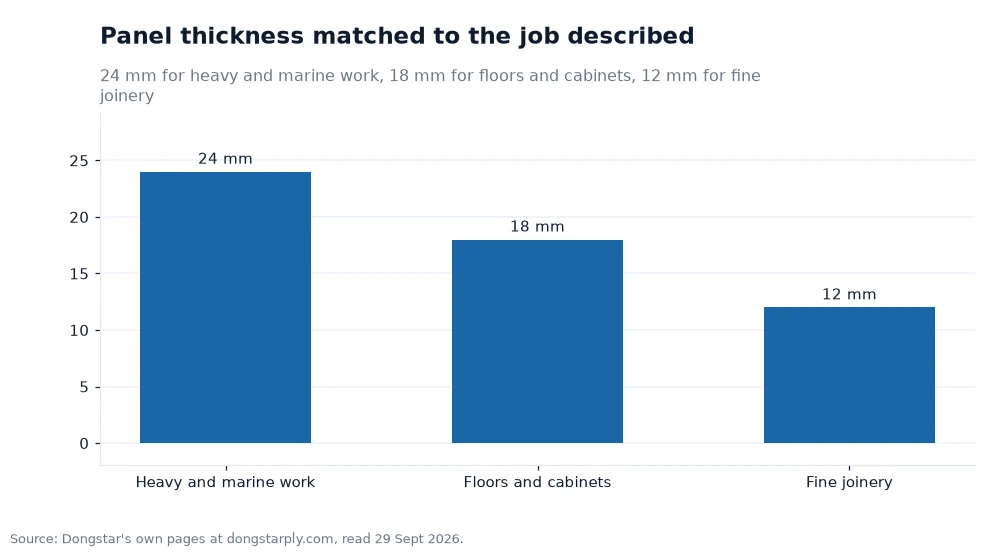
Three-quarter stock is the workhorse fraction. In a metric range it lands on the 18 mm step, and in practice that is where most cabinets, floors and structural components are specified. The 24 mm sheet sits above it and is published for heavy-duty, marine and industrial applications rather than for routine furniture.
That 1.05 mm gap between the drawing and the delivered sheet is the number worth writing down. It is invisible on one shelf, noticeable in a stack of panels that must total a fixed height, and material on a container that is measured in cubic metres rather than millimetres. Any quantity that is priced by volume, or that has to fit an opening built to a fraction, deserves the calculation.
Measuring a delivered panel against the drawing
Calipers answer a different question from a datasheet. A drawing specifies a nominal thickness, the mill presses to a target, and the delivered panel arrives somewhere within the working range that the press can hold. Measuring a stack at the top, middle and bottom of a pallet shows whether the shipment is consistent; measuring one panel shows only one panel.
The sensible habit is to check dimensional consistency on arrival against the specification that was ordered, in the units it was ordered in. A buyer who ordered 12 mm and calculates on 12.7 mm is planning against a product that was never shipped, and the error multiplies quietly through every take-off downstream.
Choosing 12, 18 or 24 mm on purpose
The application list published for Birch Plywood maps the three steps cleanly. Twelve millimetres is for fine joinery, eighteen for floors, cabinets and structural components, and twenty-four for heavy-duty, marine and industrial work. Choosing from that list, rather than from the fraction nearest to hand, is what keeps a specification honest.
Species is the other half of the decision. The panel carries the botanical name Betula Alleghaniensis, comes from Canada and the eastern United States, and is described as straight-grained, fine and even in texture, with reddish-brown heartwood and pale yellow sapwood. Those properties matter more than the fraction once a component is in service.
It also helps to write the order the way the drawing reads. A specification line that names species, thickness and format leaves nothing to interpret, so a 12 mm sheet and a 12.7 mm expectation are never exchanged by mistake. Shops with repeat work tend to keep that line in a template, which means each new enquiry starts from the last confirmed specification rather than from a fresh guess at what the fractions meant.
| Fraction | Converted | Nearest published step |
|---|---|---|
| 1/2 inch | 25.4 × 0.5 = 12.7 mm | 12 mm, for fine joinery |
| 3/4 inch | 25.4 × 0.75 = 19.05 mm | 18 mm, for floors and cabinets |
| Above 3/4 inch | No round fraction needed | 24 mm, for heavy and marine work |
| Nominal | The figure on the drawing | Ordered in the unit the drawing uses |
| Measured | The figure the calipers read | Checked against the ordered specification |
Worked example: a cabinet run in three-quarter stock
A cabinet side measures 0.6 m × 2.0 m, which is 0.6 × 2.0 = 1.2 m² per side, and the job needs 24 sides: 24 × 1.2 = 28.8 m² of panel (example arithmetic). A 4 × 8 sheet covers 1.22 × 2.44 = 2.9768 m², so 28.8 ÷ 2.9768 = 9.7 sheets, rounded to ten with offcuts kept for shelves (example).
Now run the thickness through the same job. At the fraction on the drawing, 19.05 mm, the cube is 28.8 × 0.01905 = 0.5486 m³ (example). At the 18 mm step actually supplied, it is 28.8 × 0.018 = 0.5184 m³ (example) — 5.5% less material than the drawing implies, which is why a buyer who prices from the fraction and orders the metric sheet should expect a small but measurable gap between the two figures.
Frequently asked questions
How many millimetres is half an inch exactly?
Twelve point seven millimetres, from 25.4 × 0.5 = 12.7. The published metric step nearest to it is 12 mm, which is slightly thinner than the fraction implies.
Is three-quarter stock the same as 18 mm?
Not exactly. Three-quarters of an inch converts to about 19.05 mm, so a drawing in fractions asks for roughly a millimetre more than an 18 mm panel provides at the same nominal size.
Why does pre-drilling matter on thin birch sheets?
Because the wood is dense, hard and stiff, so a screw driven straight in builds stress around the shank. On a thin panel a split near an edge leaves little material around the fixing, which is why pre-drilling is recommended.
Following the specification further
Fractions decide what gets ordered, and the datasheet decides what gets delivered. Buyers who want to see how the three thickness steps sit alongside the rest of the catalogue can review the product families in the range and read up on the manufacturer standing behind the panels.
Fractional equivalents, thickness steps and species notes derive from the company's own site, read on 29 September 2026, and carried into this write-up, and taken for this write-up[1].